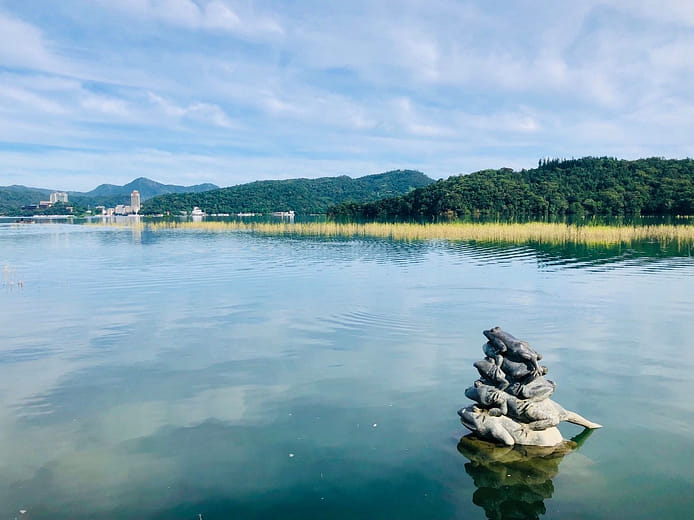
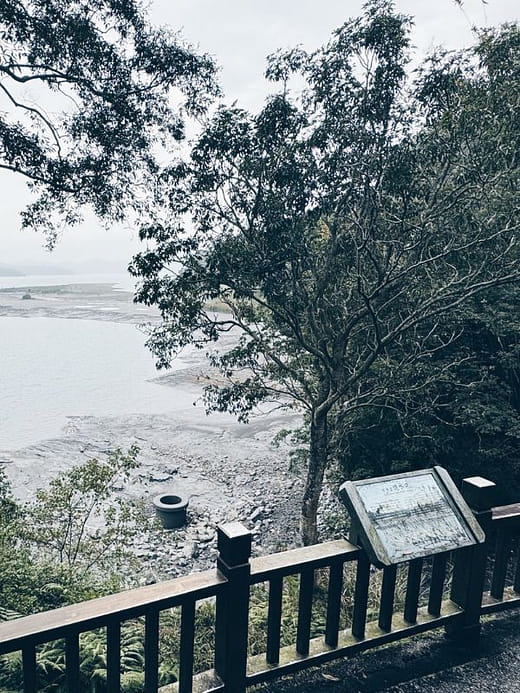
During the Japanese colonial period, there were originally two temples around Sun Moon Lake: Longfeng Temple in Shuishe Village and Yihua Hall in Riyue Village. Due to the Japanese power generation project, which caused the water level of Sun Moon Lake to rise, so both temples had to be relocated. At that time, the Japanese Electric Power Company acquired the temple assets, and the temple authorities used the funds to find a new site and merge the two temples.
In 1934, construction began on the rebuilding of Wenwu Temple on Songbolun, located on the northern shore of Sun Moon Lake, which was completed in 1938.
In 1969, the temple was rebuilt again in the style of Northern Chinese architecture. The new structure is grand in scale and imposing in appearance. The temple is divided into three halls: The front hall is dedicated to worship, with the Water Cloud Palace on the second floor honoring the founding ancestors and the God of Literature, Wenchang Dijun; the central hall is the Martial Hall, which enshrines the God of War, Guan Sheng Dijun, and General Yue Fei; the rear hall is the Grand Sage Hall, which honors Confucius and his disciples. The temple is a unique blend of Confucianism, Buddhism, and Taoism, representing diverse religious beliefs coexisting harmoniously.
The Dacheng Hall is the only Confucian temple in Taiwan that remains open 24 hours a day, symbolizing Confucius's educational spirit of "teaching without discrimination." Inside the hall, there is a bronze statue of Confucius, which is the only one of its kind in Taiwan, along with statues of Mencius and Zisi. These statues were originally enshrined in China but were moved to Japan's Sayama-fudoji Temple during the Qing Dynasty's Boxer Rebellion. After being replicated, they were transferred to Wenwu Temple. Additionally, statues of Yan Zi and Zeng Zi were later funded and created by later generations, accompanying Confucius to express reverence and remembrance for Confucian sages.
In front of the temple, a pair of massive vermilion stone lions capture the attention of many visitors. These lions were donated by Wu Huoshi, the founder of the Shin Kong Group, and are humorously referred to by the local people as "Wu Huoshi," adding a touch of fun and humanity to the temple.
The architectural style of Wenwu Temple is a highlight for visitors. The temple combines the simplicity and grandeur of northern Chinese architecture with the intricate and ornate features of southern Chinese architecture. From the finely carved dougong (brackets) and que ti (ridge supports) to the lattice network details, every element showcases the fusion and subtle differences between the two architectural styles, inviting admiration for their artistic and cultural value.