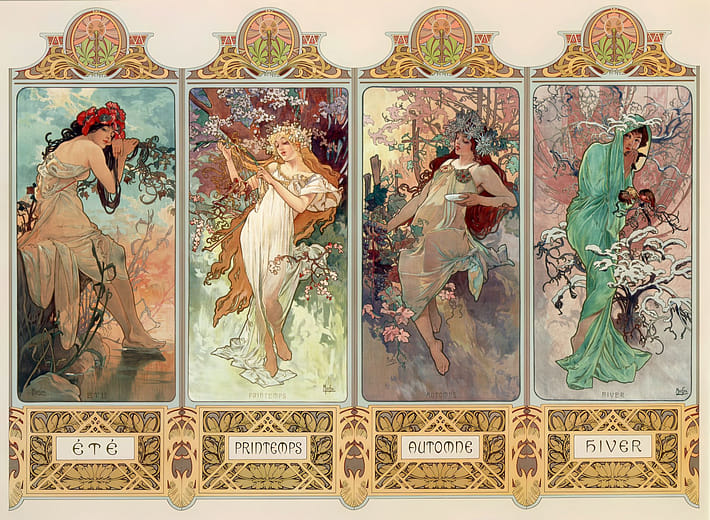
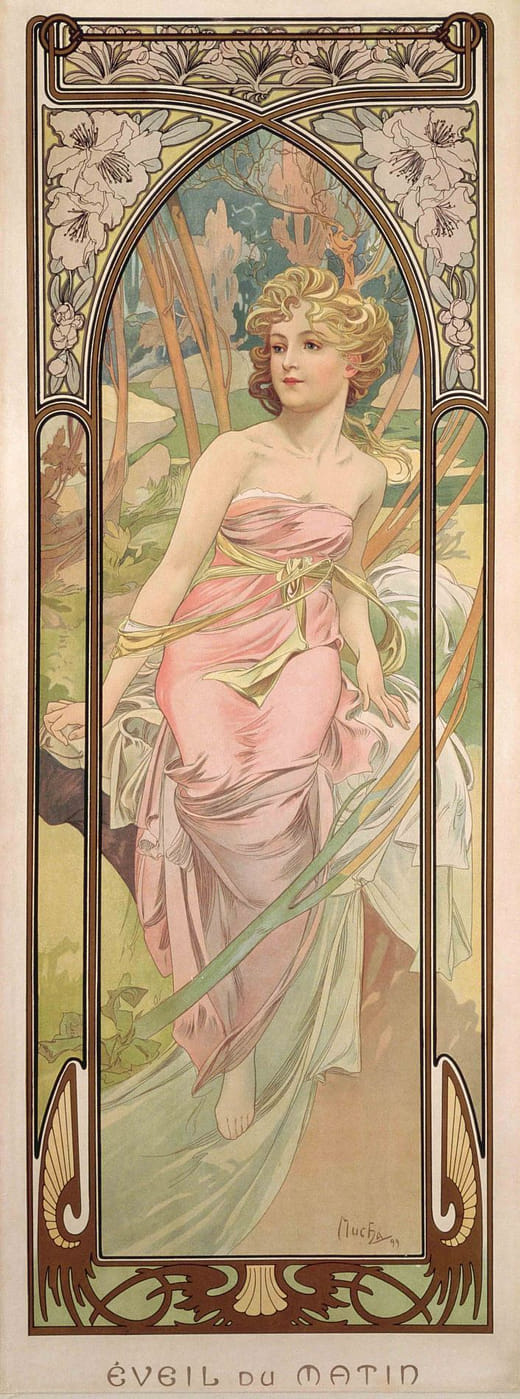
Between 1896 and 1902, Czech national treasure Alphonse Mucha began creating his celebrated quadriptych series—decorative panel sets comprising four paintings. These panels were widely used in contemporary European furniture, such as folding screens, or displayed as wall art, enhancing the aesthetic appeal of everyday spaces. The rapid advancements in printing technology following the Industrial Revolution allowed art to reach broader audiences, no longer confined to the elite but integrated into the lives of the general public. In his commercial designs, Mucha combined the spatial depth of classical European painting with the flat, stylized strokes of Japanese ukiyo-e. He further enriched his work with intricate floral and natural motifs, using elaborate, flowing lines to evoke a strong sense of exotic beauty. This distinctive style, known as “le style Mucha”, produced some of his most famous and widely loved quadriptych series.
While Mucha’s quadriptych series consistently depicted women as the central figures, their features evolved over time. Initially aligned with the slender, delicate beauty of classical European ideals, these figures gradually reflected Mucha's Slavic heritage, characterized by radiant red hair, fuller figures, and a robust, voluptuous beauty.
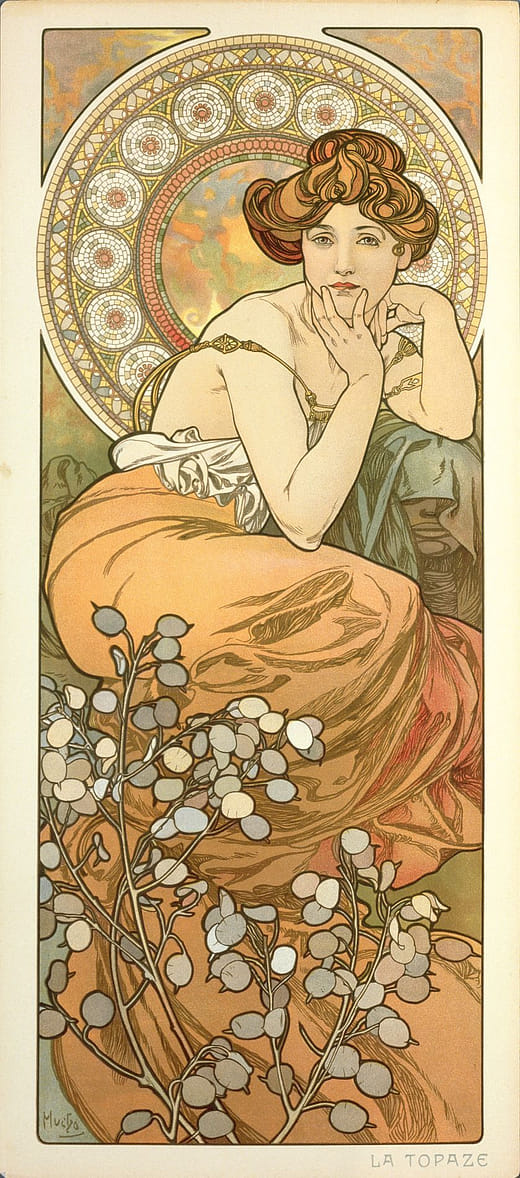
The featured artwork in this exhibition, The Precious Stones: Ruby, is part of Mucha’s 1900 Four Precious Stones series. Mucha’s extraordinary talent for jewelry design was already evident in 1898 when he created the poster for French actress Sarah Bernhardt’s play Medea. The poster showcased a snake-shaped bracelet adorning the protagonist’s wrist, a detail that highlighted Mucha’s artistic flair for intricate jewelry design. This success led to his collaboration with jeweler Georges Fouquet and marked the beginning of his ventures into jewelry creation. By the time he designed the Four Precious Stones series, Mucha was well-versed in interpreting the essence of gemstones, skillfully translating their qualities into anthropomorphic artistic representations.
In the Four Precious Stones series, four gemstones—Yellow Sapphire, Ruby, Amethyst, and Emerald—are personified by women. Each piece features a female figure in the upper portion of the composition, complemented by realistic floral decorations below. The women’s attire, hair color, and even eye color are meticulously aligned with the corresponding gemstone’s hue. By this period, Mucha’s female figures had shifted away from the earlier, ethereal slenderness of classical European beauty. Instead, they embodied the robust, voluptuous characteristics of Slavic women, with red hair, fuller forms, and radiant, expressive features.
This is the second pieces in the series, Ruby, a gemstone that exudes opulence and luxury. The woman depicted in the artwork strikes a seductive, yet somewhat haughty pose, proudly presenting her stunning ruby necklace to the viewer. Her red hair, deep crimson shawl, and the fiery blossoms below her repeatedly evoke the red tones of the ruby. The flat, stylized brushstrokes, graceful flowing curves, and intricate, elegant floral embellishments are all hallmark features of Mucha’s signature style, le style Mucha. Every detail in this work conveys the immediate impression of the ruby, with its aura of both power and captivating allure. This piece perfectly embodies the anthropomorphic representation of the ruby, bringing the gemstone to life through its vivid portrayal.