Continuing from the ruby in the Four Precious Stones series, we now encounter The Precious Stones: Topaz. Topaz, or the title itself makes it clear that this is not referring to the yellow Sapphire from the corundum family, but rather to Topaz, also known as Yellow Topaz. Despite its name, “Yellow Topaz” has no connection to jade, as it is a completely different gemstone. The reason that it is called the ‘Yellow Topaz” is because the natural Topaz features a beautiful, sunshine-like yellow color and is a common gemstone in European jewelry, often used in adornments. However, due to modern manufacturing techniques, the most commonly seen variety today is a heat-treated blue Topaz, which is harmless to the human body. Natural Topaz is still mined in countries such as Brazil and Russia. Most natural Topaz appears colorless or grayish, but it can also be brown or yellow, which sometimes leads to confusion with yellow quartz. However, Topaz differs structurally from quartz. High-quality natural Topaz is a brilliant orange-yellow with slight pinkish undertones, known as Imperial Topaz, and is often used in fine custom jewelry. This explains Mucha’s choice to depict Topaz in a warm, orange-yellow tone. In addition to his mastery in painting, Mucha was also a skilled jewelry designer, which gave him a deep appreciation and understanding of gemstones.
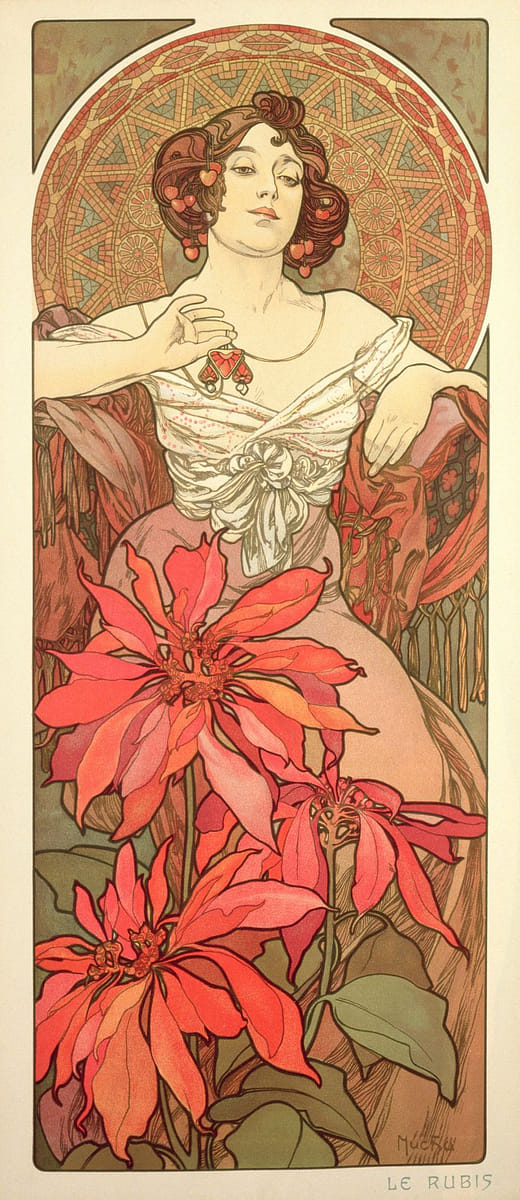
Returning to Mucha’s Topaz, this piece is actually the first in the Four Precious Stones series. Unlike the ruby, which exudes a slightly aggressive arrogance, the woman in Topaz embodies a soft, languid beauty with a hint of innocence. The warm orange-yellow tones dominate the piece, and the intricate circular motif is complemented by an ethereal, aurora-like background that shimmers with delicate colors. The overall color scheme is light, refined, and gentle. The shadows and folds of the woman’s clothing add depth, transforming the otherwise flat composition into something more dimensional. This technique reflects the influence of Japanese ukiyo-e, which was a significant inspiration during the Art Nouveau movement, resulting in a fresh, innovative fusion. Once again, Mucha’s signature “le style Mucha” shines through, beautifully showcasing the gemstone in all its dazzling elegance.