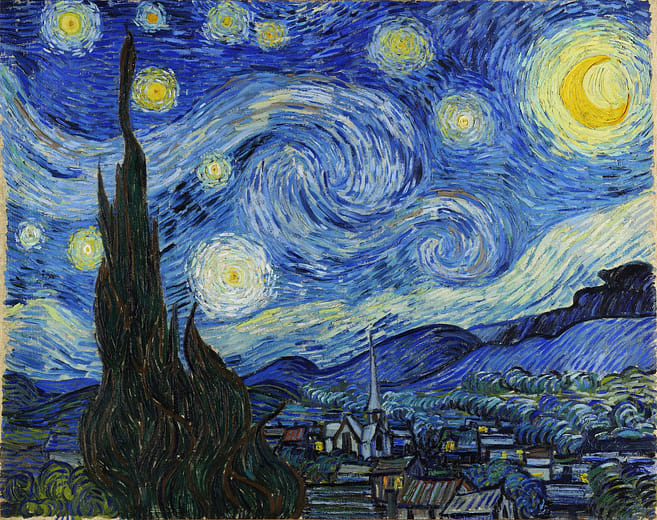
Now, under the romantic starry sky, we journey with Rousseau to explore “The Sleeping Gypsy”.
The Impressionist painter Henri Rousseau should not be confused with the Enlightenment philosopher Jean-Jacques Rousseau. Although both are notable figures in French history, they lived a century apart.
Henri Rousseau, a self-taught artist from Paris, never left his hometown, yet his imagination and paintbrush transported viewers around the globe. With an optimistic and childlike perspective, he depicted a fantastical world brimming with dreamlike, fairytale charm.
One such work is “The Sleeping Gypsy”, in which Rousseau portrays the enigmatic Romani people, often referred to as Gypsies. Without a homeland of their own, the Romani have wandered across continents, contributing their distinctive culture and talents to the places they touch. From dance and music to art and cuisine, their vibrant traditions have mingled with local cultures to create unique and beautiful expressions of humanity. When they first arrived in Europe, the Romani were mistakenly believed to be Egyptians, earning them the name “Gypsy”. In France, they were often associated with the historical region of Bohemia, which further shaped their exotic, romanticized image. In this painting, Rousseau imagines a dark-skinned Romani woman peacefully asleep under a vast, starlit desert sky. By her side lie a mandolin and a water jug, while a curious lion gazes at her with an air of quiet wonder. The composition exudes mystery and tranquility, with its rich narrative tension transforming the painting into the cover of a storybook, a poem, or a dream. Rousseau invites viewers to linger and listen, as if the painting itself is whispering a tale of wonder and discovery.