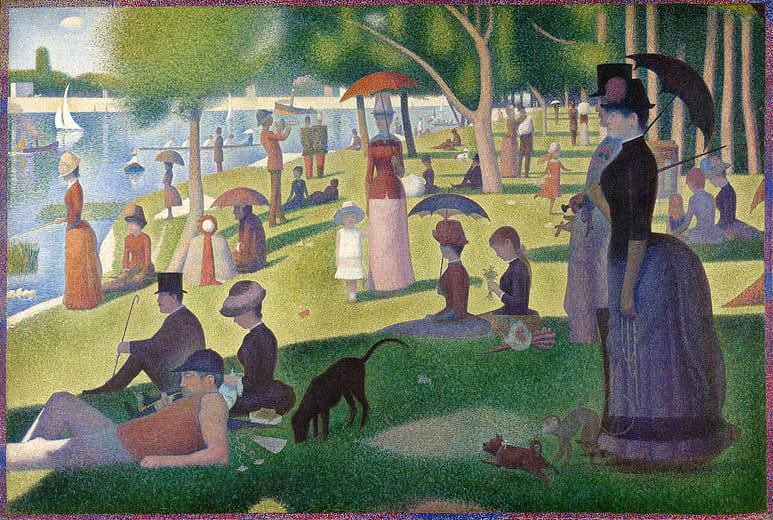
After strolling and picnicking in the beautiful afternoon park of La Grande Jatte, we follow Cézanne indoors to enjoy a game of cards.
Cézanne, often regarded as the “Father of Modern Art”, bridged the transition from late Impressionism to Cubism. In the early 1890s, he returned to his hometown of Provence, where his observations of rural life, combined with inspiration from The Young Card Players by the “Le Nain brothers”, renowned for their Baroque-era depictions of everyday life among urban and rural folk, inspired him to create five variations on the theme of card playing. These five works differ in their composition and color schemes but consistently reflect Cézanne's distinctive style.
For this 150th Anniversary Immersive Art Exhibition of Impressionism, the version selected is the one housed in the Musée d’Orsay in Paris. It is the smallest in size and the final piece in the series. Unlike other versions, this one excludes any bystanders, focusing solely on two estate workers deeply engrossed in their card game. A bottle of red wine sits between them, anchoring the composition. Notably, the two figures are not entirely contained within the canvas; the man on the left is fully visible, while the man on the right is partially cropped, extending beyond the frame. Though seemingly asymmetrical, the placement of the wine bottle between the two figures creates a sense of balance. The contours are softly defined, with light and shadow less emphasized, while the colors vividly showcase a striking three-dimensional effect.
The use of color in this painting distinctly showcases Cézanne's technique of conveying a sense of Cubist dimensionality.
After the card game, we step outside with Cézanne to scale “Mont Sainte-Victoire”.
Much like Renoir's repeated exploration of specific themes, Cézanne found himself drawn to this mountain, painting it not just a few times, but over 20 times, tirelessly revisiting the subject to capture its essence and ensure its majestic presence would endure on canvas. Using both watercolor and oil paint as mediums, Cézanne refined the mountain's lines again and again, applying thick, blocky strokes of color to depict the ever-changing light and hues cast over its surface throughout the seasons. This Mont Sainte-Victoire series wasn't created in a single burst of inspiration. Rather, it spans various periods of Cézanne's life, demonstrating his profound and enduring passion for the mountain.
Rather than focusing on what makes the mountain itself extraordinary, it is Cézanne's artistic technique that commands attention.
Under normal circumstances, human vision is dynamic and shifting, meaning we do not perceive objects as fixed on a single plane. When something is obscured, we instinctively adjust our position to find a clearer angle. Humans can move.
Cézanne’s approach to painting the mountain mirrors this fluid visual experience. Unlike other Impressionist painters who emphasize spatial depth through light, shadow, and gradations of color, Cézanne’s style does not rely on strong spatial perspective. The edges and contours of forms are not sharply defined, giving his work a familiar sense of ethereal flow.
Instead, Cézanne employs geometric blocks of color, layering and reapplying paint to build the object’s multiple facets. Through this method, he constructs the thickness and shape of the subject. Although paint often carries a sense of transparency, Cézanne’s technique uses it to construct the form of an object. His approach to painting is like “architectural drawing”, where every brushstroke is deliberate, calculated, and not guided by mere intuition. In his Mont Sainte-Victoire series, the geometric structuring sometimes creates visual tilts in certain works as he builds the three-dimensional planes of the mountain.
For this 150th Anniversary Immersive Art Exhibition of Impressionism, the chosen version showcases an expansive, open view of the mountain.