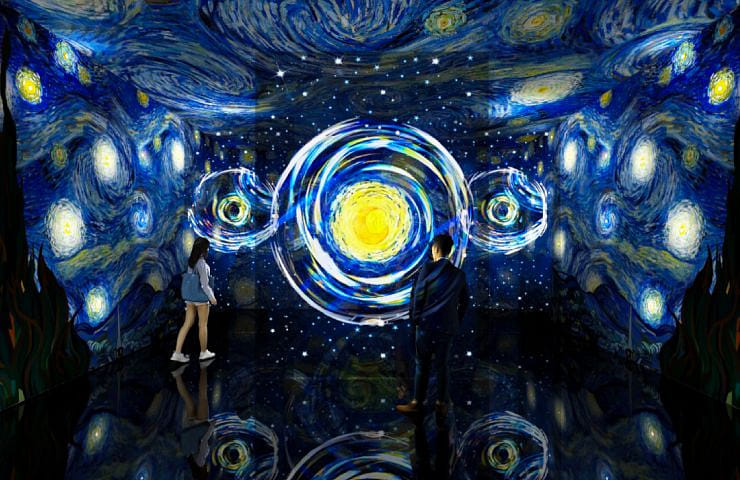
Leaving Van Gogh's bedroom, we step outside with him to gaze at the starry night sky.
The Starry Night, created in 1889, represents a pivotal year for Van Gogh, a year that could be described, in the words of Dickens' A Tale of Two Cities, as "It was the best of times, it was the worst of times."
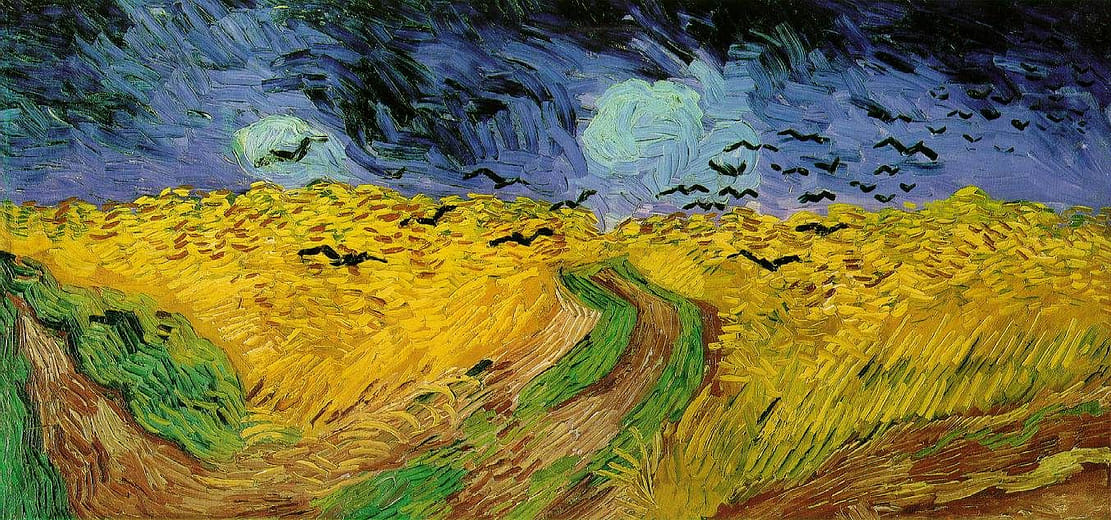
During this year, Van Gogh struggled deeply with the symptoms of a complex mental illness. Aware of his fluctuating condition, he voluntarily admitted himself to a mental asylum in Saint-Rémy-de-Provence in May. While it has been widely assumed that Van Gogh suffered from schizophrenia, a groundbreaking 2016 symposium in the Netherlands dedicated to their national treasure revised this understanding. The symposium concluded that Van Gogh's mental illness was far more intricate and episodic than previously thought, marked by unpredictable behavior and mood swings. At times, he seemed entirely disconnected from reality, while at others, his clarity and lucidity were unmistakable. Even with modern medicine, Van Gogh’s mental state defies singular classification, and this enigmatic inner world is precisely what makes his art so extraordinary and timeless. It was this tumultuous year, with its blend of chaos and lucidity, that propelled Van Gogh further into expressionism, where his works vividly conveyed his innermost feelings. His paintings during this period brim with dramatic tension, melancholic intensity, and hallucinatory imagery, giving birth to masterpieces like The Starry Night, Irises, Olive Trees, and Wheatfield with Crows.
The swirling brushstrokes of The Starry Night were a mystery when Van Gogh created the painting; no one at the time could comprehend why the celestial view appeared in this unique way to his eyes . The concept that might help explain this was first proposed in 1883 by a British scholar studying fluid dynamics. He introduced the “phenomenon of turbulence”, which describes the transfer of energy from large vortices to smaller ones in the motion of fluids. This phenomenon can be observed in natural elements like water and air. This theory had no connection to Van Gogh's work until 2004, when scientists using the Hubble Space Telescope observed swirling patterns of stardust and gas surrounding stars, reminiscent of the only artwork from the late 19th century that depicted such a phenomenon: Van Gogh's The Starry Night.
Research revealed turbulent structures within Van Gogh's paintings. By digitizing his artwork and analyzing the scientific data, researchers concluded that Van Gogh, during his periods of mental illness, accurately depicted the patterns of turbulence. They speculated that Van Gogh's unique visual perception might have been influenced by the hormonal changes in his brain during his episodes, allowing him to see a world entirely different from what others perceived. Van Gogh transformed these extraordinary and dazzling visions into masterpieces that continue to captivate the world.