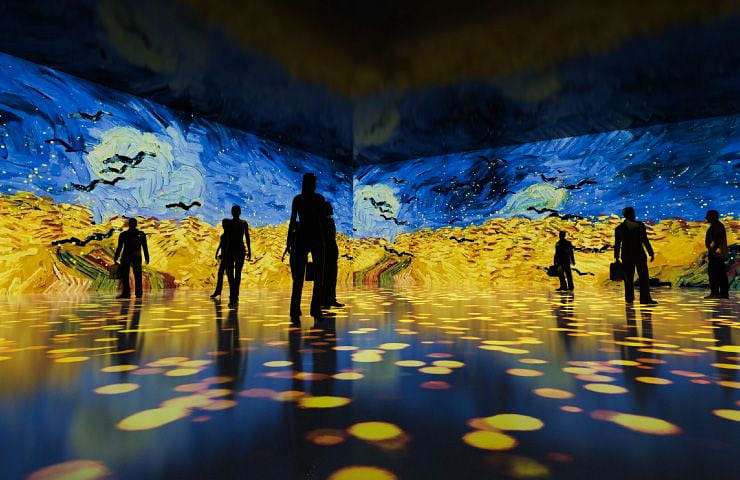
Setting aside the love-hate complexities between Van Gogh and Gauguin, we turn our gaze back to this delicate and sensitive young artist, lamenting his brief but dazzling life, akin to a shooting star.
Wheatfield with Crows is often considered Van Gogh's final work. Completed on July 10, 1890, he tragically shot himself in the chest on July 27 but did not die instantly. Wounded, he walked two kilometers to seek help, lingering for two more days before succumbing to his injuries on July 29. This tragic sequence of events has left lingering doubts among scholars and admirers about whether Van Gogh's death was a suicide or a murder, debates that persist to this day.
In the weeks leading up to this misfortune, Van Gogh had moved from the psychiatric hospital to the quiet town of Auvers-sur-Oise, north of Paris, for further treatment. During his time there, he frequently wandered into the surrounding wheat fields, seeking solace and inspiration through en plein air painting.
Wheatfield with Crows was painted during the golden season of July when the wheat ripened to its radiant hue. In the painting, a flock of black crows soars above the golden field, and the brushstrokes appear tumultuous, like waves whipped up by a fierce wind. The wheat sways wildly, bursting with agitation and intensity. The scene features three paths that stretch out into the distance, but their unclear endpoints evoke a sense of unease. Where do these roads lead? Is it to the other side of the wheatfield, or does their journey continue beyond the painting’s frame? The three paths in Wheatfield with Crows have often been interpreted as Van Gogh’s contemplation of life, death, and the destiny of the soul. But where do these roads lead? To the far end of the wheatfield, or perhaps beyond the painting's frame itself?
Speaking of the frame, the dimensions of Wheatfield with Crows differ significantly from the typical proportions of Western oil paintings. Its wide, horizontal composition closely resembles the elongated scrolls of Eastern art. The overall tone is somber and intense, as if embodying the shadows that had long lingered in Van Gogh's heart. In his final days, those shadows seem to surge forth from the canvas, vividly narrating the mental and physical exhaustion that marked his life.