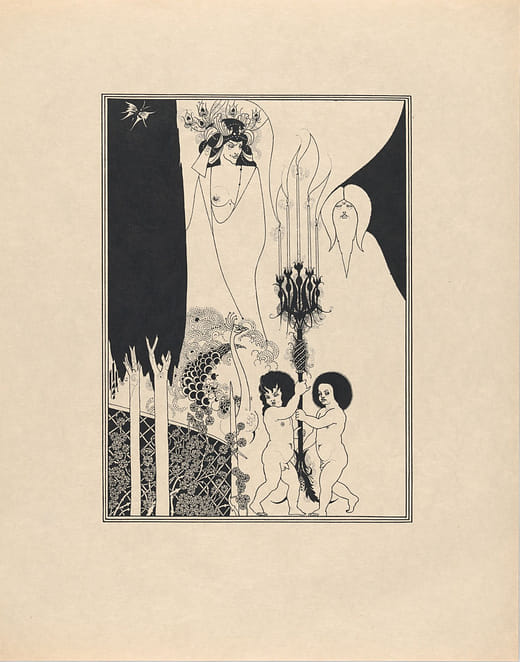
The Black Cape was created by British illustrator and writer Aubrey Beardsley. Beardsley, a key figure of late 19th-century Aestheticism, created this illustration for his friend Oscar Wilde's play Salomé.
Salomé is a real historical figure from Jewish history, as recorded in the Christian New Testament. Salomé was originally the niece of King Herod, but after her mother divorced Herod's brother and remarried King Herod, Salomé's status changed to that of Herod's daughter. During a banquet, Salomé performed a dance that pleased King Herod, who, in his delight, promised to grant her any wish. Salomé then consulted her mother on what request she should make. Unexpectedly, her mother had long harbored resentment over the remarriage, as the prophet John had directly criticized the marriage as unethical. As a result, Salomé's mother instructed her to ask King Herod for the beheading of John. King Herod, though reluctant, ultimately complied. This biblical story is often interpreted as a symbol of the union of temptation and death.
The frightening biblical story was transformed into an even more chilling one-act play by Wilde. In Wilde's version, Salomé becomes consumed by hatred after her unrequited love for the prophet John, leading her to perform the famous “Dance of the Seven Veils”. She then demands that her father, King Herod, behead John. However, after Herod fulfills her request, Salomé holds John's severed head and talks of love, rejecting her stepfather's advances. This causes King Herod to fly into a rage, and he orders Salomé's beheading in turn.
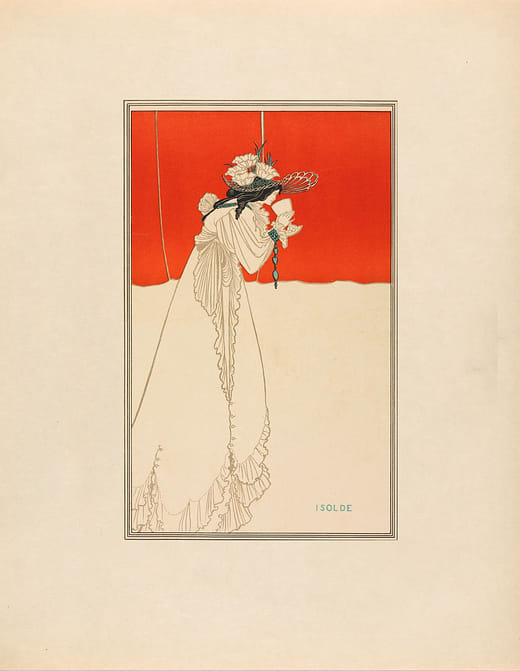
Wilde's provocative writing led to the play being banned in the UK immediately after its 1896 premiere in Paris, only to be lifted in 1931. The dark plot, combined with Beardsley’s black-and-white, eerie, and highly controversial character illustrations, heightened the shock value of this avant-garde literary work. During the late 19th and early 20th centuries, the Art Nouveau movement saw a massive influence of Japanese ukiyo-e and Eastern culture on Western art. Beardsley was part of this cultural fusion and innovation. In his work, elements of Japanese culture are evident, such as linear lines, flat compositions, and large color blocks, all characteristic of ukiyo-e. In The Black Cape, Salomé’s exaggerated six-layered costume and her skirt, resembling a kimono with inward and outward curves, are paired with a background of negative space and contrasting black blocks. Her pose further reflects the traditional stance of a Japanese geisha.
Beardsley’s brushwork brought the image of the beautiful, seductive, dangerous, and decadent Salomé to life, leaving a lasting impact on subsequent films and stories inspired by this portrayal of her.