The Golden Period, also known as the “Golden Age”, marks the creative peak of Austrian artist Gustav Klimt. Many of his world-renowned works were created during this period, including The Kiss.
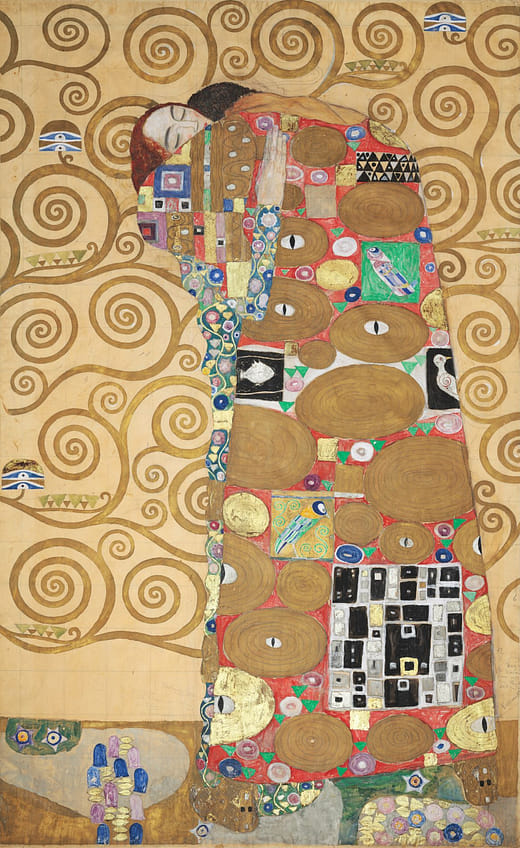
This painting, begun in 1907 and completed in 1908, is the final work of Klimt's Golden Period. It features abundant gold and silver leaf, and its composition reflects the influence of Japanese ukiyo-e, which was popular in European art at the time. Departing from traditional European classical perspectives, Klimt adopted flat, linear compositions. The image of a couple embracing in flowing robes, viewed through the lens of early 1900s post-Victorian conservatism, was considered provocative and sensual. In fact, many of Klimt's works carry underlying references to human passion, as he did not view human desire as shameful.
The swirling, colorful patterns in the painting symbolize feminine emotions. The soft, sinuous curves of the woman's body represent her physical form, contrasting with the sharp, angular black-and-white patterns on the man's clothing. A belt, featuring similar spiral shapes, wraps around her waist, hinting at emotional intensity and desire. The radiant golden hues further enhance the color blocks on their robes. The couple kneels on a meadow filled with various flowers, with the scattered petals and green leaves on their bodies mirroring the natural elements of the scene.
The identities of the figures in this artwork—whether they represent the artist himself and his lover, or someone else—remain a mystery, leaving room for various interpretations and speculations. While Klimt's The Kiss is undoubtedly one of his most popular and fortunate works, instantly receiving worldwide admiration upon completion and immediately acquired by the Austrian government, its significance is unquestionable. Even during the Nazi occupation of Austria, when many artworks and artifacts were destroyed, The Kiss was preserved and continues to be displayed at the Belvedere Museum in Vienna, an iconic masterpiece of the Art Nouveau movement and a beautiful and moving interpretation of love.