The Tree of Life appears in many myths, religions, and cultural traditions worldwide, though the interpretations vary. It is generally associated with eternity, life, fertility, and death, embodying the concept of a divine tree that connects life and death, heaven and earth. Gustav Klimt's Tree of Life was commissioned for the “Stoclet Palace”, a private mansion in Brussels, Belgium, belonging to the Stoclet family. This residence, not open to the public, was designed by Josef Hoffmann, a prominent member of the Vienna Secession during the Art Nouveau movement. Hoffmann’s work on the palace is regarded as a masterpiece, making it one of the most exquisite and luxurious private homes of the 20th century.
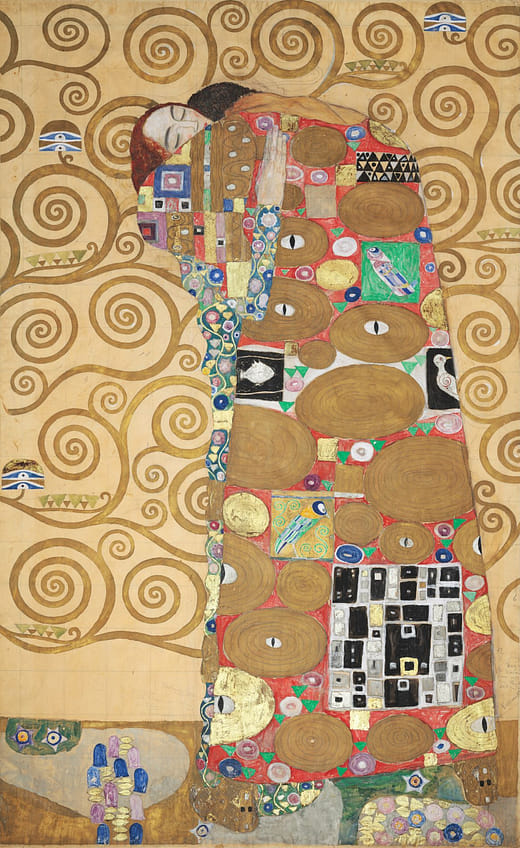
In addition to commissioning a renowned architect, the Stoclet family also opted for high-end custom décor and hired the famous Austrian painter Gustav Klimt to create murals for the dining room. Klimt produced three pieces: Standing Female Figure, Lovers, and Tree of Life. These works belong to the artist's late creative period, known as his “Golden Period”. During this time, Klimt favored oil painting techniques and gold leaf to create works with an Oriental influence, rich in mystery and opulence. Although Klimt was primarily known for his portraits during this period, Tree of Life stands out as his only landscape-themed work from the Golden Period.
The Tree of Life in the painting features spiral, swirling branches that symbolize the cyclical nature of life and death. The branches reach toward the sky while the roots anchor deep into the earth, embodying the tree's role as a connection between heaven and earth, a concept central to many cultural myths about the tree of life. Klimt incorporated numerous geometric shapes, such as triangles, circles, and squares, as decorative motifs. The circular, seed-like patterns that frequently appear in his works are often interpreted as metaphors for female eggs, symbolizing the endless vitality of life, the birth and growth of all living beings, and their eventual return to the earth. The tree also features a black bird, which in many mythologies is seen as a messenger of death, symbolizing mortality. In this artwork, it seems that Klimt is reminding us that all life has both a beginning and an end. The entire piece exudes a powerful sense of spirituality and offers a solemn reminder of the cycle of life and death.