〈Water-Lily Pond. Symphony in Green〉,〈Red water lilies〉,〈Nympheas〉
Claude Monet
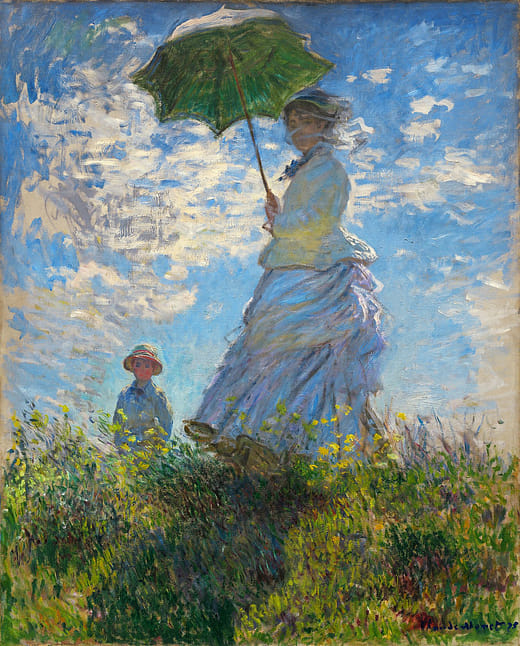
After the passing of his beloved Camille, we shift our gaze with Monet from “Woman with a Parasol” to the water lily pond he built in later years, sharing his life with his second wife.
In 1883, Monet moved to the tranquil village of Giverny on the outskirts of Paris, where he began constructing a stunning water garden. This idyllic haven became the fulfillment of his dream to merge art and horticulture, creating a space where beauty and inspiration flourished side by side. In this garden, Monet painted over 250 works in his celebrated Water Lilies series. As time passed, his use of color grew increasingly vibrant, and his canvases expanded in scale. Early pieces measured around one meter in length and width, but later works reached monumental proportions, with some stretching as long as six meters.
Monet was meticulous about his beloved garden, carefully planning the placement of flower beds to align with the seasonal sunlight and harmonize their colors. His paintings evolved from depicting broad landscapes, such as skies, forests, seas, sunlight, and mist, to focusing entirely on the intricate ecosystems of his water lily pond.
In “Water Lily Pond: Harmony in Green”, the central Japanese arched bridge divides the composition into two realms: the real and the reflected. The flowers and their mirrored images on the water's surface invite the viewer to linger, captivated by the interplay of reality and illusion.
Monet held a deep admiration for Japanese art, amassing an extensive collection of ukiyo-e woodblock prints over his lifetime. This influence is evident in his early work, such as “Camille Monet in Japanese Costume”, where he explored Japanese aesthetics through his muse. In his later years, Monet seamlessly blended his lifelong appreciation of Japanese art with his Impressionist techniques, creating works that exude a profound sense of cultural fusion. This synthesis is particularly reflected in the design of his garden at Giverny, where the Japanese-style arched bridge and water lily pond became recurring subjects in his later masterpieces.
Compared to The Water Lily Pond: Harmony in Green, Monet’s Red Water Lilies, painted several years later, reveals a significant shift in his style. By this time, Monet’s eyesight had deteriorated considerably, but his mastery of color had grown bolder and more vibrant. The flowers in Red Water Lilies are strikingly vivid, while the pond reflects shimmering, rainbow-like hues, creating a composition bursting with life and energy. The visual richness of the painting is a testament to Monet’s evolving relationship with color, as celebrated by French writer Marcel Proust, who once remarked: “In Monet’s works, the colors he creates in the flowers and their surroundings are more precious, more moving than the flowers themselves”.
Having strolled through the verdant green of the Japanese bridge and admired the brilliance of the red water lilies, we now arrive at Monet’s final masterpiece in the Water Lilies series.
This masterpiece, created in 1916, reflects the evolution of Monet’s art as he adapted to the challenges posed by his vision. Diagnosed with cataracts in 1912, Monet’s condition influenced his use of color, making it more vivid and expressive. He moved away from traditional methods that emphasized precise contours, instead focusing on the interplay of light and shadow to depict the nuances of his water lily pond. Monet developed a unique technique of layering colors directly on the canvas without pre-blending the pigments. Unlike traditional approaches that sought seamless transitions, Monet’s method created bold, distinct brushstrokes. Up close, the strokes may appear chaotic, yet they convey a sense of spontaneity and emotion. When viewed as a whole, these overlapping colors and textures add incredible depth and vivid richness to the composition.
The changing light from dawn to dusk, the shifting colors of the seasons, and the variations brought by weather—all the nuances of Monet’s garden were immortalized through his brush, leaving an enduring legacy for the world to enjoy and admire.
Although Monet had no formal training in architecture or landscaping, his design, maintenance, and artistic transformation of his beloved garden revealed the boundless creativity of a true artist. Each stroke on his canvas was a testament to his ability to capture the beauty and essence of nature.