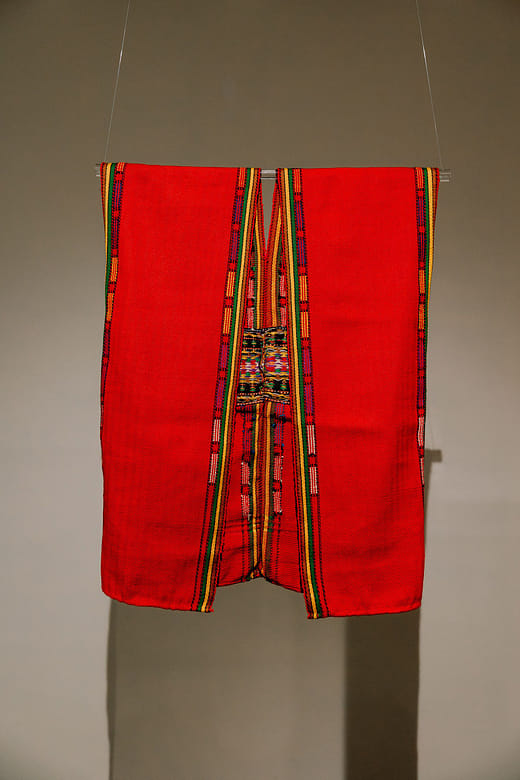
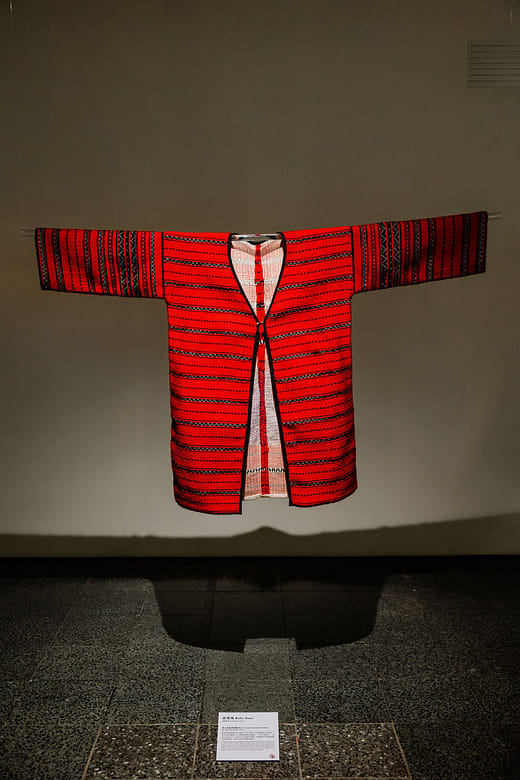
苧麻 Ramie /37 x 235 cm
介紹
按傳統工序工法製作苧麻線材,織布前須經種植、採集、刮麻、積麻、紡線等繁複工序,將採集後的生麻刮除雜質、取纖,與米糠一同搓揉,連續數日以「日曬夜露」方式進行漂白;再以搓捻、銜接方式將一根根較短的麻,使其成為細長、均勻的線。其後經紡錘紡紗、上框架整理成線圈後成為線材備用。染煮線材以木灰、九芎葉汁、薯榔等天然植物為染料,製作紡織材料,作法乃是將切片後的薯榔與麻線,以水煮或槌搗、浸染方式使顏色呈紅棕色;取sero(九芎)葉汁與麻線搓揉、攪拌並埋置於稻田泥土中數日以染製黑色。織紋技法係以ratu緯挑組織構圖,織作較繁複的大菱紋,傳統上此織物用於縫製hilo蓋被及sapo鋪蓋之床墊,近年來則取為桌巾或垂掛於牆壁裝飾。
Introduction
This work is made of ramie thread according to the traditional process. Before weaving, it must go through complicated processes such as planting, collecting, scraping, piling, and spinning. The collected raw hemp is scraped to remove impurities, remove fibers, and rub it with rice bran. Bleaching by "sun and night dew" for several consecutive days; and then twisting and connecting the shorter pieces of hemp into slender, even threads. It is then spun on a spindle and organized into coils on the upper frame to become a wire for later use. Dyeing and boiling thread uses natural plants such as wood ash, Ligusticum japonica leaf juice, and potato nut as dyes to make textile materials. The method is to boil the sliced potato nut and twine, then boil or hammer them, and then dip-dye them to make the color reddish brown; The juice of sero (Jiuxiang) leaves is rubbed with twine, stirred and buried in the soil of the rice field for several days to dye it black. The weaving technique uses a ratu weft pick pattern to create a more complex large rhombus pattern. Traditionally, this fabric was used to sew hilo quilts and sapo mattresses. In recent years, it has been used as tablecloths or hung as wall decorations.