你寫我們就演-多瑙河畔的深造與體驗 You Compose, We Perform — Study and Revelation by the Danube
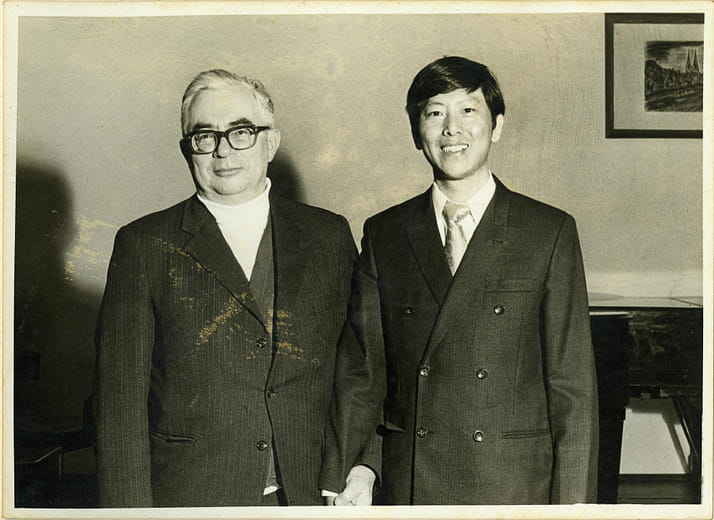
1972年,馬水龍獲得了德國雷根斯堡聖樂院全額獎學金,為了理想,飛向遙遠的歐洲。在這個多瑙河與雷根河交會處的古城,師事席格蒙教授(Dr. Oskar Sigmund),他既是作曲家,也是音樂學者,在音樂史與美學方面給與 馬水龍很多啟發。馬水龍經常到慕尼黑聆賞音樂會、歌劇。在努力學習現代音 樂技法之餘,他也體會到自身文化的問題。他體會到,18世紀的巴赫(J. S. Bach)在融會貫通各國音樂技法後,先創立了德國風格的音樂,然後才成為世界性的大師;而20世紀的巴爾托克(Béla Bartók)出生於奧匈帝國,音樂語言則吸收了故鄉匈牙利及周遭地區民間音樂養分,「感動」是他創作的泉源。巴爾托克最後成為舉世聞名、影響後世甚鉅的作曲家。
「如何走出自己的路?文化發展和歸屬」一直是馬水龍關切的問題,在德國短短的二、三年,他有很豐富的創作,就如他說的,這些作品「洋蔥味」很重,如《長笛幻想曲》、管風琴曲《展技曲與賦格》等,不帶東方標題。畢業時正值學校歡慶百年,他個人作品發表會得以擠身其中,並代表校方於雷根斯堡音樂節、柏林電台、慕尼黑電台公開發表播送,而演出者都是音樂院的教師。
In 1972, Ma Shui-Long was awarded a full scholarship to the Regensburg Academy of Sacred Music in Germany. Driven by artistic ideals, he set off for Europe in pursuit of deeper musical knowledge. In this historic city at the confluence of the Danube and Regen rivers, he studied composition under Dr. Oskar Sigmund—a composer and musicologist whose teachings in music history and aesthetics had a profound influence on Ma’s thinking.
During his time in Germany, Ma frequently traveled to Munich to attend concerts and operas. While immersing himself in contemporary compositional techniques, he also began to confront deeper questions about cultural identity. He reflected on how Johann Sebastian Bach, in the 18th century, synthesized the techniques of various European traditions to establish a uniquely German musical language before becoming a global master. Similarly, in the 20th century, Béla Bartók—born in the Austro-Hungarian Empire—drew upon the folk music of his native Hungary and neighboring regions. For Bartók, emotion was the true source of creation. Through this cultural rootedness, he shaped a distinctive musical voice that would leave a lasting mark on world music.
“How does one forge their own path? Where does cultural development and belonging begin?”
These questions remained at the heart of Ma’s artistic inquiry. Though his stay in Germany was relatively brief—just two to three years—it was a remarkably productive period of composition. As he would later say, many of these works were “strongly onion-flavored”—a playful way of noting their Western aesthetic orientation and lack of overt Eastern references. Works such as Fantasy for Flute and Toccata and Fugue for Organ exemplify this phase.
Upon graduation—coinciding with the academy’s centennial celebrations—Ma was invited to present a solo concert of his compositions as part of the official festivities. His works were also featured at the Regensburg Music Festival and broadcast publicly by Berlin and Munich radio stations. All the performances were given by faculty members of the academy, affirming the high regard in which his music was held.