南投竹產業的廢料新生 Rebirth of Bamboo Waste in Nantou’s Bamboo Industry
南投竹產業的廢料新生
Rebirth of Bamboo Waste in Nantou’s Bamboo Industry
A.竹廢料與它的產地
南投是與竹共生的山林基地,也是臺灣竹產業復興的重要據點。這裡不僅孕育出職人技藝與工藝文化,更累積了豐厚的材料知識與產業鏈網絡。隨著竹產業的發展,南投每年產出各式形色不一的竹廢料,這些過去被視為無用的切屑與邊角,正透過地方企業的投入被重新定義。竹育股份有限公司長期與周邊竹產業合作,系統化回收並進行定性與定量的研發測試,將竹廢料製成可穩定應用的竹造粒,導入各類循環再利用產品中,讓竹子以嶄新的姿態重返生活,形塑綠色材料的完整循環路徑。
A.Bamboo Waste and Where to Find It
Nantou is a mountainous region that has long coexisted with bamboo—home to both Taiwan’s bamboo craftsmanship and its industry revival. Beyond nurturing artisanal skills and craft traditions, Nantou also carries deep material knowledge and an active production network. As the industry grows, it produces a wide variety of bamboo waste—offcuts and scraps once seen as worthless and now being redefined through local innovation.
Chu Yuh Co., Ltd. collaborates with surrounding bamboo producers to systematically collect, sort, and test bamboo waste. Through continuous testing and refinement, they turn discarded fragments into stable bamboo granules used in circular products—bringing bamboo back into daily life and shaping a complete green materials cycle.
▍竹育股份有限公司現場照片及提供的各類竹產業廢料狀態 (照片:C-Cube)
Chu Yuh Co., Ltd. — On-site view and provided bamboo waste materials (photo: C-Cube)
▍竹育股份有限公司針對竹餘料進行定性定量研究,產出竹造粒,並開發許多延伸產品,是促進產業循環的一大關鍵。
Through research and product development based on bamboo residues, Chu Yuh Co., Ltd. plays a vital role in promoting circularity in the bamboo industry.
B-1.碳權交易的「黑金」竹廢料生物炭研究
生物炭,由生質物經熱解所製,是一種富含孔隙、可長期固碳的碳質材料,已被廣泛應用在農業、建材、環保與工藝領域。根據歐洲生物炭認證機構定義,生物炭不僅可作為碳匯儲存媒介,更可在製造過程中取代化石碳,成為低碳時代的關鍵材料。本展區介紹由成功大學航太系陳維新教授 GenFuel 實驗室,透過專利低溫焙燒技術所產製的竹生物炭,開啟南投竹廢料的全新再生之路。
常見的生物炭應用:
農業土壤改良、促進植物生長 ; 更低碳綠色的建材 ; 工藝設計與材料創新 ; 環境修復與污染治理 ; 電池應用的明日之星。
B-1."Black Gold" of Carbon Credit Research on Bamboo Biochar
Biochar is a porous carbon material made by pyrolyzing biomass. Known for its long-term carbon storage, it is widely used in agriculture, construction, environmental applications, and craft. According to the European Biochar Certificate, it can also replace fossil carbon during production—making it a key material in the low-carbon era. This section presents bamboo biochar developed by Professor Wei-Shin Chen’s GenFuel Lab at National Cheng Kung University. Using patented low-temperature pyrolysis, the team transforms bamboo waste from Nantou—opening a new path for bamboo regeneration.
Common Applications of Biochar:
Soil enhancement and plant growth; Low-carbon green construction; Craft design and material innovation; Environmental remediation and pollution control; Emerging applications in energy storage and batteries.
材料演化流程
前處理:乾燥、破碎
根據原料狀態不同,進行焙燒的前處理,本次取得的竹造粒,大幅節省相關前處理工作。
(圖說搭配:焙燒前處理)
厭氧焙燒
材料在厭氧狀態燒製,可取得生物炭。GenFuel 團隊可將溫度控制在200-300度的低溫焙燒,更為節能減碳。
(圖說搭配:焙燒後)
後製
根據下游應用的不同,進行後續的破碎、分篩等規格化處理。
Material Evolution Process
Pre-treatment: Drying and Crushing
Depending on the raw form, biochar production may require pre-treatment. The bamboo granules used here significantly reduce that workload.
Caption: Pre-treatment for pyrolysis
Anaerobic Pyrolysis
The material is carbonized in an oxygen-free environment. GenFuel’s system allows precise temperature control at 200–300°C, maximizing energy efficiency and carbon reduction.
Caption: Biochar after low-temperature pyrolysis
Post-processing
Biochar is crushed, sieved, and standardized depending on downstream applications.
閱讀手上的一把炭─工藝視角下的材質表情
生物炭根據用途的不同,會進行不同的性質分析。作為工藝材料時,會特別關注其顏色、質感、吸附性與穩定性等特性,以評估其是否適合用於塗料、複合媒材或成型物件等創作應用。除了視覺與觸感的表現外,生物炭本身的環保價值與低碳屬性,也讓它成為新世代永續工藝媒材的重要選擇。透過材質的實驗與搭配設計的創新,生物炭不僅是材料,更是與自然共生、訴說循環故事的創作基底。
Reading a Handful of Charcoal: Material Expressions Through the Lens of Craft
The properties of biochar vary depending on its intended use. When viewed through a craft lens, attention shifts to its color, texture, absorbency, and stability, which determine its suitability for use in coatings, composite materials, or molded forms. Beyond its visual and tactile appeal, biochar also holds environmental significance. Its low-carbon nature positions it as a compelling material for sustainable craft practices. Through material experimentation and design innovation, biochar becomes more than a medium—it is a co-creative agent with nature and a storyteller of circularity.
竹生物炭測試要點 Key Testing Points for Bamboo Biochar
1.會不會發霉?(水活性)
水活性0.5aw 以下較好,不會發霉 (一般食品規範不發霉要求標準為0.6 aw)
Will It Mold? (Water Activity)
Water activity below 0.5 aw is ideal and prevents mold growth. (The general food safety threshold to avoid mold is 0.6 aw.)
2.親水還是疏水?(接觸角)
水滴下去的瞬間,水滴與試體表面的角度呈現90度以下為「親水」、90度以上為「疏水」。
90度以下親水、90度以上疏水
Hydrophilic or Hydrophobic? (Contact Angle)
A surface is hydrophilic when the water contact angle is below 90°, and hydrophobic when above 90°.
竹生物炭分析數據 Bamboo Biochar Analysis Data
1.元素分析 Elemental Composition
碳:73.19% 氫:2.79% 氮:1.17% 氧:22.85%
C:73.19% / H:2.79% / N:1.17% / O:22.85%
2.水活性 Water Activity:0.469aw (防霉)
Water Activity: 0.469 aw (Mold-resistant)
3.接觸角:具吸水性,量測不到任何液珠
Contact Angle: Fully absorbent: No measurable droplets detected
解讀竹生物炭的數據密碼 Decoding the Material DNA of Bamboo Biochar
1. 穩定的碳結構:
竹生物炭碳含量高達73%,擁有穩定又堅固的碳結構,可以長時間固定二氧化碳,等於把碳鎖在材料裡,幫助減緩氣候變遷,同時也讓材料更耐用。
2. 元素搭配,提升潛在功能性:
氫(H)、氮(N)、氧(O)等元素的存在,賦予生物炭表面豐富的官能基,這些元素能幫助它和其他材料更好地結合,也能增強吸附力,讓材料更強韌、功能更多元。
3. 長效抗霉,提高建材穩定性
水活性值僅0.469aw,代表生物炭本身能有效防霉抗菌,特別適合應用在室內牆面或隔熱材料上,讓空間更乾爽、衛生。
4. 吸濕調控能力
生物炭之接觸角極小,代表表面很容易吸水,具備調節空氣濕度的能力。它可以幫助環境吸收空氣中的水氣,讓室內更舒適,也能減少建材因潮濕而損壞的機會。
1. Stable Carbon Structure
With a carbon content as high as 73%, bamboo biochar forms a stable and robust carbon structure capable of long-term CO₂ storage—essentially locking carbon inside the material. This not only helps mitigate climate change, but also enhances the durability of the material itself.
2. Elemental Synergy for Functional Enhancement
Hydrogen, nitrogen, and oxygen contribute to the formation of surface functional groups that improve compatibility with other materials and boost adsorption capacity—resulting in stronger, more versatile applications.
3. Long-Term Mold Resistance
A water activity level of just 0.469 aw makes it highly resistant to mold and bacteria. Ideal for use in interior walls and insulation to maintain dry, healthy spaces.
4. Moisture-Regulating Capacity
The extremely low contact angle indicates strong water absorption, enabling biochar to moderate humidity. This helps maintain indoor comfort while reducing the risk of moisture-related damage.
生物炭建材的四大特性 Four Core Features of Biochar-Based Building Materials
高碳固存|提升耐久,鎖住碳足跡
元素強化|氮氧協助,增強性能
低水活性|優異防霉,健康無憂
超強吸水|智慧調濕,延長壽命
High Carbon Fixation|Long-lasting durability and embedded carbon
Elemental Enhancement|Nitrogen and oxygen improve performance
Low Water Activity|Mold-resistant and healthier environments
Exceptional Water Absorption|Humidity control extends lifespan
C.循環漿體竹炭系列
C.C-Slurry Biochar System
C-Slurry 循環漿體是一種以低碳循環為目標的材料創新技術,由國立成功大學建築學系劉舜仁教授團隊研發。它不使用傳統水泥,也不需高溫燒製,而是利用各種工業與營建廢料,在常溫下進行化學反應,轉化成具有結構強度與設計彈性的材料。C-Slurry 已經發展出超過300種配方,能應用於牆面、傢俱、裝置藝術及建築空間等,真正實現廢棄物的再生利用,是推動循環經濟和永續設計的重要材料平台。
透過一系列的試驗與測試,將竹產業的餘料與竹生物炭進行探索,形成「C-Slurry Biochar 材料圖譜」,將竹餘料透過改質與升級回收,進入蝴蝶圖另一個資源循環系統的封閉循環。
C-Slurry is a low-carbon material innovation developed by Professor Angus Shuenn-Ren Liou’s team at the Department of Architecture, National Cheng Kung University. It replaces traditional cement and high-temperature firing with ambient-temperature chemical reactions using industrial and construction waste. With over 300 mix designs, C-Slurry is used in walls, furniture, installations, and architectural spaces—transforming waste into value and advancing circular, sustainable design.
In this series, bamboo residues and bamboo biochar are tested and refined to form a “C-Slurry Biochar Material Atlas,” upgrading bamboo waste into a new closed-loop within the ”resource butterfly system.”
循環漿體 竹炭系列的技法演化:澆注、發泡、3D列印
Technique Evolution of the C-Slurry Biochar Series: Casting, Foaming, and 3D Printing
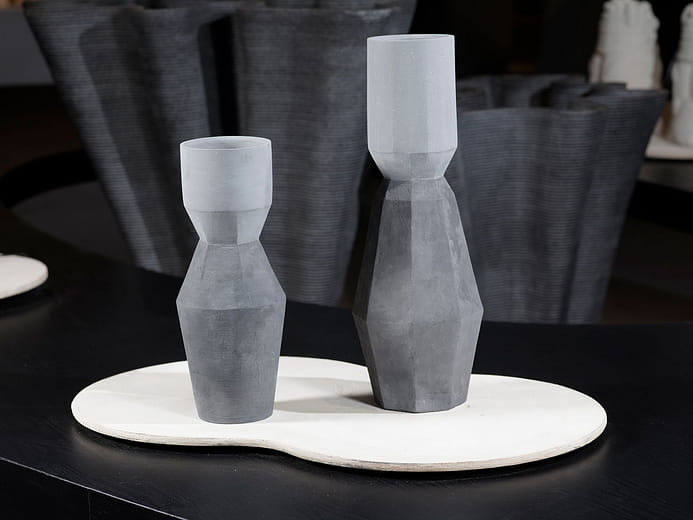
1. 澆注 Casting|形構日常的再生美學
在澆注工法中,C-Slurry 宛如液態石材,隨著模具流動、凝結,賦予創作與建築或家具部件嶄新的生命。這種常溫成型技術,不僅節能環保,更讓回收廢料得以化身為獨一無二的創作紋理,將循環經濟的精神具體帶入日常空間。
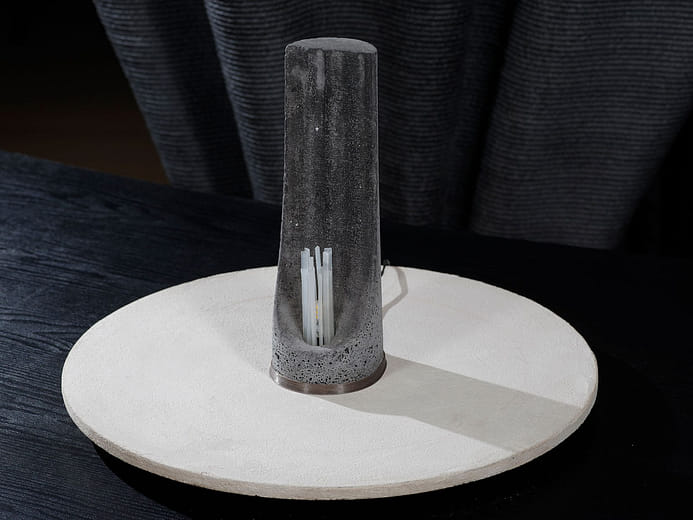
2. 發泡 Foaming|輕盈中的多孔想像
經由發泡工法,C-Slurry 成為輕質多孔的材料載體。這些內含無數細微氣孔的結構,不僅賦予建材保溫、隔音的實用功能,更能成為產品創作、城市綠化、景觀設計,乃至生態復育的新媒介。材料的輕盈,使運用充滿彈性,而多孔的特性,則讓人重新想像材料與自然共生的可能。
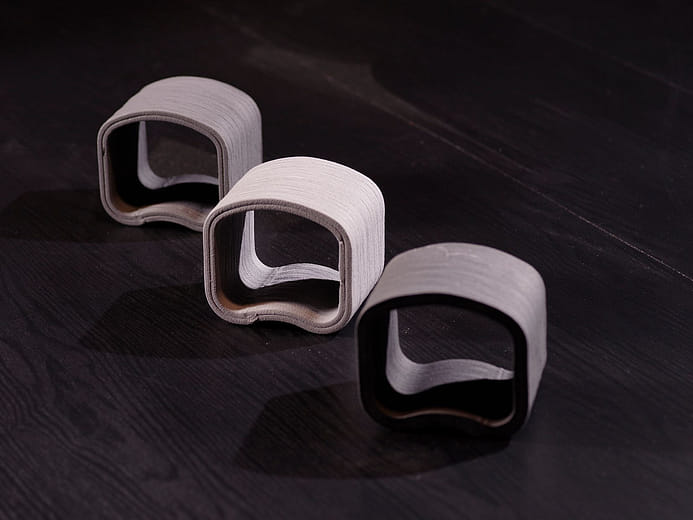
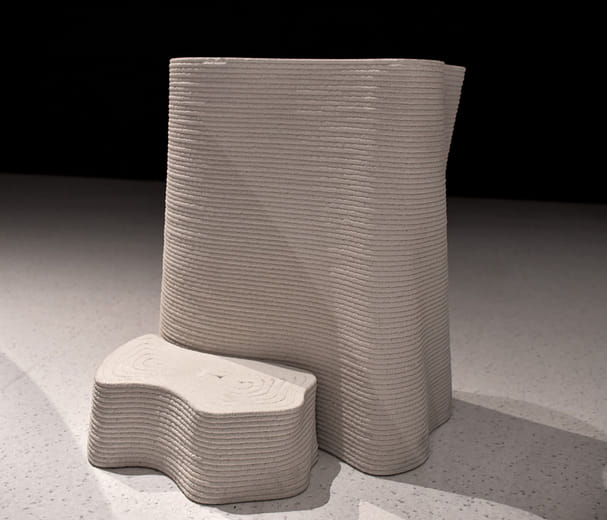
3. 3D列印 3D Printing|數位時代的自由構築
當 C-Slurry 融入3D列印工法,材料成為數位設計的延伸語言。透過程式與機械手臂的協作,不受傳統模具侷限,自由地構築複雜、參數化的結構。這讓建築構件與藝術裝置從理想到現實僅一步之遙,也讓循環材料真正進入「量身訂做」的未來場景。
1. Casting|Everyday Regeneration Aesthetics
In casting, C-Slurry flows like liquid stone, filling molds and solidifying into new architectural or furniture components. This low-energy forming method gives waste materials unique textures and reintroduces circular aesthetics into everyday spaces.
2. Foaming|Lightweight and Porous Imagination
Through foaming, C-Slurry becomes a lightweight, porous material. Its fine pore structure offers insulation and sound absorption, while also serving as a new medium for product design, urban greening, landscape use, and ecological restoration. Its lightness allows flexible application, and its porosity inspires new ways to reconnect materials with nature.
3. 3D Printing|Digital Freedom in Forming
Integrated with 3D printing, C-Slurry becomes a language of digital construction. Robotic arms build complex, customized forms without molds—bringing circular materials into a future of precision-made design.